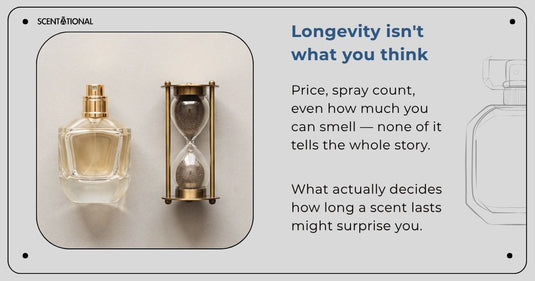
"This perfume doesn't last" is one of the most common complaints in the fragrance world — and honestly, most of the time, the perfume isn't the problem. There's a lot more going on than just what's in the bottle. Let's clear up what actually controls how long a scent sticks around, and bust a few myths you've probably heard.
First, What Does "Lasting" Actually Mean?
Before we get into the myths, worth knowing: fragrance doesn't just switch off after a set number of hours. It fades in stages (remember top, middle and base notes from our last post?), and "longevity" usually refers to when you — or someone standing close to you — can still detect it at all. That number can honestly vary wildly, even for the exact same bottle.
Myth #1: "EDP always lasts longer than EDT"
Mostly true, but not the whole story. Concentration absolutely plays a role — more fragrance oil generally means longer wear. But it's not the only factor, and a well-made EDT with strong base notes can outlast a poorly-blended EDP. Concentration is a good starting signal, not a guarantee.
Myth #2: "If I can't smell it, it's gone"
False — and this one trips up almost everyone. Your nose adapts to smells it's constantly exposed to, so you stop noticing your own perfume way before it's actually faded for people around you. This is called nose fatigue, and it's the reason you might spray "one more time" at noon when you really didn't need to.
Myth #3: "Spraying more makes it last longer"
Not really. Once your skin has absorbed what it can hold, extra sprays mostly just sit on top and evaporate faster — you're not adding staying power, you're adding a stronger initial blast that fades at roughly the same rate. Two or three well-placed sprays on pulse points beats five random ones.
Myth #4: "Expensive perfume always lasts longer"
Not necessarily. Price often reflects rare ingredients, brand positioning, or packaging — not longevity. Some budget-friendly fragrances are formulated with strong, long-lasting base notes (musk, amber, woods), while some expensive niche scents are intentionally light and close-to-skin by design. Price is not a reliable longevity predictor.
So What Actually Controls Longevity?

Here's what genuinely makes a difference:
- Skin type. Oily skin holds fragrance longer than dry skin, since oil helps "trap" the scent molecules. If you have naturally dry skin, fragrance will fade faster no matter what you're wearing — that's not a flaw in the perfume.
- Where you spray it. Pulse points (wrists, neck, behind ears) run warmer, and heat helps release fragrance steadily over time.
- The note profile. Heavier base notes like amber, musk, oud, and vanilla cling longer than light citrus or aquatic top notes. A fragrance built mostly around citrus will almost always feel like it "disappears" faster — because it's designed to be light, not because something's wrong.
- Weather and humidity. Heat and humidity make fragrance project more but can also cause it to burn off faster. Cold, dry air makes scent stick closer to skin and last longer, but project less.
- Moisturized skin. A fragrance-free lotion under your perfume gives the scent something to hold onto, which can genuinely extend wear time — this is a real trick, not a myth.
Quick Tips If You Want More Longevity
- Moisturize unscented skin before spraying — dry skin doesn't hold scent well.
- Spray on pulse points, not just clothes (though clothes can hold scent longer than skin — a mix of both works well).
- Don't rub your wrists together after spraying — it can break down the top notes faster.
- Choose scents with amber, musk or woody bases if all-day wear matters more to you than a light, fresh feel.
- Layer a matching body lotion or oil underneath, if the brand offers one — it gives the fragrance a better base to hold onto.
The Real Takeaway
If a perfume feels like it fades fast on you, it's not automatically a bad bottle — it might just be a lighter note profile, your skin type or plain old nose fatigue talking. Once you know what's actually driving longevity, you can shop smarter: check the note breakdown, lean toward richer bases if all-day wear matters to you, and stop blaming the bottle for something your skin or nose is doing.

Featured above: Hugo Boss Orange EDT (Fruity Floral) · Michael Kors Wonderlust Eau de Voyage EDP (Floral Marine) · JPG Ultra Male Intense EDT (Warm & Intense) · Ralph Lauren Romance Elixir EDP (Floral Gourmand)
Check out our full collection and take a look at the note breakdown on each product page — it'll tell you a lot more about expected longevity than the price tag will.